

Author:
Ilze Mailīte
Traditional craft skills
Title
Weaving on Pēteris Viļumson's Semi-Automatic Single-Treadle Looms (2020)
Geography
Across Latvia, not associated with any specific locale. People travelled to weaving courses from across Latvia during the first three decades of the twentieth century to learn to weave. Today Viļumsons looms are found countrywide.
The community comprises weavers (both individuals and legal entities) with access to Viļumsons looms, loom owners, and responsible individuals.
Weavers and other interested parties are active across Latvia (in Briģi, Līvāni, Vīpe, Smiltene, Staicele, Skujene, Sarkaņi, Biksēre, Kusa, Madona, Gulbene, Ērgļi, Rīga, Jelgava, Dobele, Jaunpils, Lauciene, Tukums, Talsi, Stende, Ventspils, Kuldīga).
Significance in Community Life
Viļumsons semi-automatic single-treadle looms should be considered a milestone in the development of loom construction in Latvia in the early twentieth century.
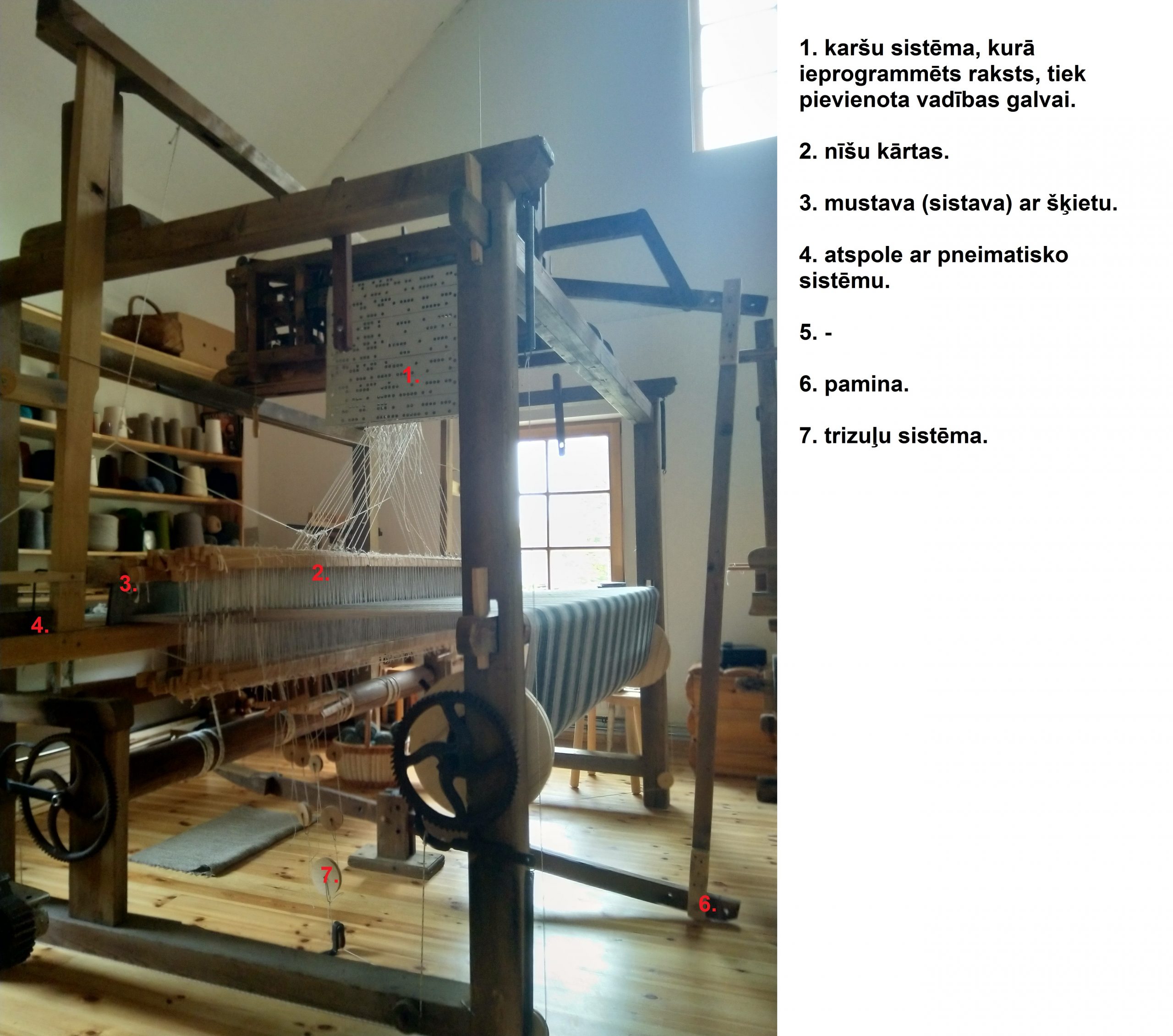
Looms usually have either jack or counterbalance mechanisms, as well as harnesses and two or more treadles. Textiles and their patterns are created through the interconnected action of these three components.
Instead of a jack or counterbalance mechanism, Viļumsons looms have a head connected to as many as 32 shafts and a single treadle. The looms may have a number of different heads. Viļumsons’ Small Machine has a cylindrical head while his Large Machine has a three-row head. Viļumsons’ Even Better Machine has a four-row punch card system. The card system consists of many cardboard punch cards of a specific size containing perforations that program the pattern. This system allows weavers to create textiles with complex patterns up to 2.15 metres in width, which is not possible on ordinary jack or counterbalance looms.
The weaving process consists of the weaver stepping on the treadle, one card is read, the relevant harness is lifted, the pneumatic shuttle travels through the shed from one side to the other, the treadle is released and the weft thread is beaten manually into place.
Viļumsons’ loom was a significant innovation and undeniably an important step in the history of weaving. It should be understood as a development that was cut short during the Soviet period.
Today, everyone who has had the opportunity to work on a Viļumsons loom feels both pride and excitement because they understand this work is not solely about fabric production; there is also the understanding that this act of weaving safeguards skills and traditions. Weaving on a Viļumsons loom demands patience, understanding, and a desire to learn, which makes the satisfaction involved in taking a finished textile off the loom so much greater.
At this time, it is not possible to give an exact figure for the number of weavers working on Viļumsons looms, but it could be approximately eighty individuals.
Activities / Practices
Interest in Viļumsons looms was generated by Inese Mailīte, president of the Sarkaņi Craft School’s weaving group from 2015 until 2017. Before then no other craft studios or groups owning a Viļumsons loom had shown much interest in the necessity of reviving this uniquely Latvian invention.
As soon as the loom arrived in Sarkaņi, the task of promoting and studying this loom began. The work at Sarkaņi came to an end, but the study of Viļumsons and his looms was taken up with new enthusiasm by Ilze Mailīte, who founded SIA Mailīšu Fabrika [Mailītes factory] and is responsible for this submission.
SIA Mailīšu Fabrika completed two projects funded by the State Culture Capital Foundation, which involved:
• Creating a Viļumsons knowledge network. Digitalization of material (2017);
• Further development of the Viļumsons knowledge network. Preparation of material for digitalisation and their digitalisation (2019).
The handbook “Viļumsona stelles un raksti” (Viļumsons’ looms and patterns), Ērgļi, 2019, was developed and published in honour of Viļumsons’ 147th birthday on November 17, 2019. This material is available free of charge here:
https://www.dropbox.com/sh/dl3cqj67cw763av/AAAmlcfUUZ8Q1m62Er1Lw_ANa?dl=0
This site also includes a survey that Ilze Mailīte prepared to ascertain where Viļumsons looms are located. Questionnaires were distributed to known loom owners, weaving studios, and hobby group leaders. Completed surveys continue to be submitted along with information about existing looms. Completed forms can also be found on this site.
The State Culture Capital Foundation approved an application for funding on 25.9.2020 to develop technical drawings for the wooden loom components of Pēteris Viļumsons’ semi-automatic single-treadle loom with a four-row head.
In many instances, it is no longer possible to draw a distinct dividing line between the work down by Inese Mailīte, Ilze Mailīte and SIA Mailīšu Fabrika. To date, consultations have been provided on the assembly and operating principles of the Viļumsons loom and the weaving process to the Sarkaņi Craft School, the Gulbene County History and Art Museum, the Ventspils House of Crafts, SIA Austras raksti, and others.
Every year we participate in projects related to Viļumsons looms or weaving on them, either as lecturers or as learners. In 2020, it was at the Gulbene Municipality History and Art Museum’s event Jūlijs rada [July is creative], in the project Notvert un paturēt gaistošo [Catch and hold the ephemeral] at the Māzers tradecraft centre. Another event focussed on understanding the structural, functional, and weaving principles of the Viļumsons loom. We also participated in the Ventspils Museum project on Safeguarding Ancient Trades and Fulfilling Interests.
Anete Karlsone’s study of weaving traditions, which includes a section on Viļumsons looms, is another noteworthy contribution.
Beliefs, rituals, and unwritten rules
Even though no stories or folk beliefs have been documented in relation to weaving on Viļumsons looms, the weaving community is aware of certain unwritten rules or recommendations whereby looms come to be identified with their maker:
• The Viļumsons loom prefers that weaving be done by a calm and level-headed person who is convinced of their need to weave on this loom;
• At the beginning. the weaver is tested by a number of tasks;
• If the weaver is careless in their treatment of the loom in any way, the Viļumsons loom does not allow itself to be utilized to its full potential.
There is a mystical and inexplicable story associated with the Gulbene History and Art Museum which has a Viļumsons loom. Prior to the opening of the Divi Jūliji festival, preparations for the workshops were taking place which included weaving on the Viļumsons loom. There have been five such preparatory days in the space of three years. On three occasions, while Inese Mailīte was at the loom a colourful butterfly appeared. The first time it landed on her shoulder, the second time it took a good look at all the heddles, while on the third, it sat on a window watching everything that was happening.
Transmission and Passing Down
To develop skill, a loom is needed, along with a weaver who understands the structure of the loom and knows how to weave fully utilizing all of its functions. As noted above, Viļumsons looms are of three types: those with a cylindrical head and those with three- or four-row punch-card systems. Viļumsons published four books (with multiple reprints), which provided an overview of the basic principles of weaving theory, but contained little information about the workings of the Viļumsons head and its construction because he held courses in artistic weaving where students learned what they needed.
At this time, no looms with the cylindrical head are in use. It is expected that SIA Mailīšu Fabrika will be the first place where it will be possible to see this type in action.
In weaving groups skills are transferred from one weaver to another. In places that we know have looms with three-row card systems, almost all functions are being utilized.
However, where looms with four-row card systems have been set up, their full functionality is not being fully utilized because of a shortage of parts and a lack of expertise. They are being used like three-row card systems, but there are good reasons to expect that this type of loom will be restored completely by SIA Mailīšu Fabrika. After a plan is worked out, the expertise and skills will be documented and passed on to others.
History
Pēteris Viļumsons (1872–1939) was the first Latvian who was both a weaver and loom maker. He invented and patented his own version of a single-treadle loom bringing European (France, Great Britain) weaving influences into Latvia.
Viļumsons was born in Vilce but worked in Jelgava (then Mitau) and Rīga, organizing travelling instructional courses in Latgale and other locations. There are unconfirmed reports that he had studied at the Royal Academy in London and spent time in Omsk and Moscow.
Until the beginning of the twentieth century, weaving in Latvia was done on counterbalance and jack looms. Viļumsons patented three new, modern weaving machines: Lielupes Viļņi (Lielupe waves, 1903), Daugavas Viļņi (Daugava waves, 1923), and the Rakstu aušanas mašīna (Pattern weaving machine, 1927). The Lielupes Viļņi was the most widely used version with three models—the Small Machine, the Large Machine and the Even Better Machine with the Pattern Advancer. These machines were mostly utilized by weaving artisans.
After World War II, less and less weaving was done on Viļumsons looms. In the best-case scenario, they were put away in woodsheds or storehouses because of their large size (width of 3.5 metres and height of 3 metres). Many others were incinerated when weavers ceased their work.
Currently, the Viļumsons loom and associated weaving skills are undergoing a revival, looms are being sought out, and instructional courses are in development.
At this time, about eighty weavers work on Viļumsons looms; however, it would be an overstatement to say that people really know how to use these looms, because none of the Viļumsons looms operate with the full functionality envisioned by Pēteris Viļumsons.
Over a century ago, Pēteris Viļumsons invented a new type of modern loom, commenced its manufacture, all the while offering courses and publishing four instructional books that were reissued several times. One of these books, “Trešdienas rīts” (Wednesday morning), contained patterns by Jūlijs Madernieks which could be woven on a Viļumsons loom. Weavers who completed his courses spent three or more days learning about the looms, their construction, and how to weave on them. Press reports of the time tell us the courses were well attended. Weaving on looms such as these was presented as a source of income.
In postwar Latvia, these looms were either put into storage or destroyed, and weaving skills were lost with the death of each weaver.
After independence was regained, a wide variety of knowledge and skills emerged from hiding—some well preserved, some almost lost. One of the latter was the skill of weaving on Viļumsons looms. It is noteworthy that Pēteris Viļumsons, a Latvian, living in Latvia, invented and patented these looms. For this reason, these skills must be preserved, passed on and celebrated, so that more weavers can learn to weave on these looms and identify their component parts to fully restore and make use of them. Today we have a unique opportunity and a path to adventure as we create textiles on these looms.
Additional Information
It is important to have prior weaving experience and skills which makes weaving on the Viļumsons looms much easier.
Masters
• Māris Maniņš, TLMS “Rīdze” leader, Folk Art Master in weaving;
• Anete Karlsone, ethnographer, researcher in the history of weaving;
• Inese Mailīte, Folk Art Master in weaving.
Institutions and Organizations
All organisations that keep the circulation of knowledge of the Viļumson loom active are important: museums, craft schools, centres, companies, studios, circles and other legal and natural persons.
www.vilumsonspeteris.com
• TLMS (People's Applied Art Studio) “Staicele”;
• Tukuma Weavers' Workshop (a branch of the Tukums Museum) and TLMS “Durbe”;
• TLMS “Smiltene”;
• Gulbene Regional History and Art Museum and TLMS “Sagša”;
• Sarkaņi Craft School;
• Craft Center “Māzers”;
• Ventspils House of Crafts (Ventspils Amatu māja);
• Association “Traditional Culture Initiatives Center 'KasTe'”;
• Association “Work and Culture Center 'Līdumnieki'”;
• Jaunpils Craft House;
• Stende Weavers' Club;
• Intangible Cultural Heritage Center “Upīte”;
• TLMS “Varavīksne”;
• Latvian Agricultural Museum;
• SIA “Austras raksti”;
• TLMS “Rīdze”;
• The Ethnographic Open-Air Museum of Latvia;
• Private individuals: Dace Martinova, Kristīne Brūkle, Sigita Šermukšne, Mudīte Meldere, Daira Drozdova, Ilze Kukāre.
Consolidation
Work completed toward safeguarding skills related to weaving and the Viļumsons loom includes:
• The material compiled by Inese and Ilze Mailīte published as “The Looms and Patterns of Viļumsons”, with an appendix including a questionnaire to ascertain where Viļumsons looms are located in Latvia;
• Active participation and consultation in various activities associated with Viļumsons looms (e. g., Ventspils Craft House, Gulbene Municipality History and Art Museum, SIA Austras raksti);
• Excursions and masterclasses at SIA Mailīšu Fabrika where participants punched and stitched together punch cards, and tied heddles with special metal eyes. The process was explained and participants allowed to try weaving on the loom. The masterclass at the Third International Art Festival in Gulbene in 2020 once again demonstrated that interest in weaving on Viļumsons looms has increased. The four-hour-long masterclass was attended by ninety people;
• Ilze Mailīte commenced research on Pēteris Viļumsons’ life. To date, the archives of the Royal Academy in London for 1890 to 1895 have been consulted because it seemed possible that was the period when Viļumsons could have been there. We have also enquired about documentation at the Latvian Chamber of Crafts and the Latvian Chamber of Commerce and Industry, but nothing was found;
• The website vilumsonspeteris.com has been established, where up-to-date information regarding this value is published;
• Consultations have been provided (both in person and over the phone), and masterclasses have been conducted;
• Several projects funded by the State Culture Capital Foundation (VKKF) have been implemented, which are described in more detail in section A.12.6.;
• In 2022, no new projects were written; however, active work took place on collecting fabric samples. All results can be viewed at vilumsonspeteris.com;
• In July 2022, Pēteris Viļumsons and his loom were featured on one of the days of the International Folklore Festival “Baltica”;
• In August 2022, Pēteris Viļumsons and his loom were highlighted on Latvian Radio 3 in the segment “Vai zini?” (Did you know?), produced by Dina Dūdiņa Kurmiņa;
• In 2024, a presentation was demonstrated and a talk was given about Pēteris Viļumsons during the “Vēveru dienas” (Weavers' Days) organized by the Ethnographic Open-Air Museum of Latvia.
Thanks to active activity, places that already have Viļumsons looms emphasize their existence. It is a testament that Viļumsons looms have become a recognisable and interesting brand. The owners of looms – private individuals – “drag” them out of both warehouses and sheds (Basi, Briģi, Biksēre, Kusa, Bārbele, etc.), express interest in knowledge and practical skills to weave on the Viļumsons looms purchased by family members.
Past and projected funding:
1. In 2014, in response to Inese Mailīte’s request, the Latvian National Centre for Culture sent a letter to the Madona Municipality in support of the purchase of a Viļumsons loom;
2. The State Culture Capital Foundation supported the following projects:
• 2015. Anete Karlsone. Ancient Half-Forgotten Skills: P. Viļumsons’ Looms in Latvia;
• 2016. Inese Mailīte. Researching the Skills of Weaver Pēteris Viļumsons, Safeguarding This Intangible Culture Heritage, and Bringing It into Contemporary Practice;
• 2017. Inese Mailīte. The book, “The Looms and Patterns of Viļumsons”, SIA Mailīšu Fabrika; Development of the Viļumsons Knowledge Network; Digitalization of Materials;
• 2018. “Divi Jūliji” [Two Julys] project at the Gulbene Municipality History and Art Museum;
• 2019. SIA Mailīšu Fabrika. Development of the Viļumsons Knowledge Network; Preparation of Material for Digitalization and their Digitalization; “Divi Jūliji, Straume” project at the Gulbene Municipality History and Art Project;
• 2020. “The July Creates” project at the Gulbene Municipality History and Craft Museum; the Māzers Craft Centre project Capture and Hold the Ephemeral; the Ventspils Museum project Safeguarding Ancient Crafts and Fulfilling Interests; the project submitted by SIA Mailīšu Fabrika to the State Culture Capital Foundation to Develop Technical Drawings for Wooden Components of Pēteris Viļumsons Semi-Automatic Single-Treadle Four-Row Head.
• Passing on the Knowledge and Skills of Pēteris Viļumsons’s Semi-Automatic Single-Treadle Looms 1 (9,189.00 EUR, VKKF), during which:
– The information repository website vilumsonspeteris.com was created;
– Information about Pēteris Viļumsons and his looms stored in Latvian museum collections and archives was identified and uploaded to vilumsonspeteris.com;
– The hypothesis that Viļumsons studied at the Royal Academy in London was disproved;
– A computer, projector, printer, and two reeds suitable for Viļumsons' looms were purchased;
– Visual instructional material was created—a fabric with 32 shafts (nīšu kārtas).
• The Process of Preparing and Weaving a Double-Weave Blanket on Pēteris Viļumsons' Semi-Automatic Single-Treadle Loom (278.00 EUR, VKKF), during which:
– Photographic documentation and detailed descriptions of the fabric preparation and weaving process were carried out (pattern selection, warp calculation, threading the heddles, sleying the reed, creating the card system, forming the edges using a weight system, tying-up, and weaving with two shuttles using the capabilities of the shuttle box lifting mechanism);
– The information was uploaded to vilumsonspeteris.com.
2023.
• Passing on the Knowledge and Skills of Pēteris Viļumsons' Semi-Automatic Single-Treadle Loom 2 (3,830.00 EUR, VKKF), during which:
– Visual instructional materials were created: woven fabrics, along with prepared texts, diagrams, and drawings for the respective fabrics;
– The presentation “Pēteris Viļumsons – Master of Looms and Contraptions” (Pēteris Viļumsons – steļļu un šteļļu meistars) was created;
– An event featuring the presentation and a small exhibition viewing was conducted in five locations in Latvia (Vilce Culture House, Gulbene Regional History and Art Museum, Vīpe Craft Center, Latvian Agricultural Museum in Talsi, and the “Līdumnieki” Work and Culture Center). The presentation and exhibition were also shown at the Sarkaņi Craft School and the Drabeši Manor Craft House. Total number of visitors—82.
2024.
• Passing on the Knowledge and Skills of Pēteris Viļumsons' Semi-Automatic Single-Treadle Loom 3 (3,660.00 EUR, VKKF), during which:
– Archive research, processing of archival materials, and preparation for website integration were completed, with everything uploaded to vilumonspeteris.com;
– Information regarding the awards and medals won was clarified and uploaded to vilumonspeteris.com;
– Sites associated with Pēteris Viļumsons in the vicinity of Vilce and Augstkalne were surveyed. Based on information discovered in the Archives indicating that Viļumsons was born in “Zirņu krogs”, the remains of this inn's building were found with high probability, and a grave with the surname “Viļumsons” written on the headstone was located in Vaiteņi Cemetery. The Berķene School is also located near “Zirņu krogs,” about which further information still needs to be sought – it could confirm the possibility that Viļumsons studied at this school;
– During the surveying trips, meetings took place with local regional historians.
Co-funding was also contributed personally, and voluntary work was carried out by answering phone calls or meeting with interested individuals in person at the weaving workshop.
Continuation and Development
SIA Mailīšu Fabrika will continue to:
• offer consultations and masterclasses;
• compile information from questionnaires and update their website.
There are also plans to undertake research at the State Historical Archive of Latvia to learn more about the courses that took place, who their graduates were, as well as the building and sale of these looms.
There are also plans to prepare further grant applications to the State Culture Capital Foundation.
Measures planned for the safeguarding and developing of the Element:
• Restoration and promotion of Viļumsons looms located at the SIA Mailīšu Fabrika;
• Study of the operating principles and functionality of the Viļumsons looms through practical experimentation in order to understand where parts should be placed and how exactly the head works;
• Promotion of operating skills for the Viļumsons looms in the community and to other interested parties (e. g., video on operating principles, training sessions and trips).
Starting from 2025, over the next five-year period, activities will proceed in two directions –
research and an illustrated story book:
1. Research – This year it will be decided whether further research will be conducted in the Latvian State Historical Archives or not. In the event that the researcher finds appropriate answers to the questions of interest in 2025 and indicates that it is still possible to find new information in the coming years, this work will continue in subsequent years.
2. Creation of an Illustrated Story Book – The development of the book will take place in several stages:
• First stage – Writing the text portion (in both Latvian and English). The presentation of this stage will take place at the end of 2025 at the House of Traditions and Crafts (Dzīvesziņas un arodu sēta) in Jelgava. On the day of the presentation, a small exhibition of works woven on Viļumsons’s loom will also be opened, with the main emphasis placed on older works (20th century) or parts thereof, though modern woven fabrics will also be on display;
• Subsequent stages of the illustrated story book will depend on available funding. In 2026, it is planned to create the book's illustrations; it is difficult to predict how many there will be, as it depends on the text portion currently being written. In 2027, it is planned to publish the book itself, which will bear the same title as the heading of the website: “Steļļu un šteļļu meistars” (The Master of Looms and Contraptions). The presentation of the booklet is planned for 2028 in several locations across Latvia, so that as many people as possible can become acquainted with Pēteris Viļumsons, thereby promoting Viļumsons' loom weaving skills even more widely.
The objectives of these activities:
• To draw attention to the first Latvian-made looms by Latvian Pēteris Viļumsons;
• To develop further understanding of the potential of Viļumsons looms, including as many interested parties as possible with a special focus on younger generations;
• Plan annual events and masterclasses, with weavers, interior designers, and graphic artists, to ensure that textiles woven on Viļumsons looms are contemporary and appropriate for interiors;
• Promote cooperation and mutual assistance for the acquisition of knowledge and skills in the community;
• To gain confidence that weaving on Viļumsons looms represents a confluence of both intangible and tangible material value.
Threats
Suboptimal utilization of loom functionality could lead to the loss of these skills. This can be seen by comparing extant looms and the weaving that is taking place.
Applicant
SIA Mailīšu Fabrika, reg. no. 45403047358
Image Gallery


Publications
Karlsone, A. (2018). The Loom Constructor and his work. Published in Archaeology and Ethnography. Latvian Institute of History.
Alsupe, A (1982). Weavers in Vidzeme (19 th century and early 20 th century). Riga: Zinātne
Viļumsons, P. (1904). Monday Morning. The first book of patterns for weavers. Jelgava
Viļumsons, P. (1904). Tuesday Morning, or the Second Book of patterns for Weavers. Jelgava.
Viļumsons, P. (1905). Wednesday Morning. The third book of patterns for weavers. Jelgava: Author's publishing house, Stengmanis book printing house
Viļumsons, P. (1911). Thursday Morning. The fourth book of patterns for weavers. Jelgava.
Viļumsons, P., ([1912]). Monday Morning. The first book of patterns for weavers. Second, extensively revised edition from P. Viļumsons in Jelgava. Jelgava.
Viļumsons, P., ([1923]) Monday Morning. The first book of patterns for weavers. Third extensively revised edition from P.Viļumsons, Riga.
Viļumsons, P. (1923). Thursday Morning. The fourth book of patterns for weavers. Riga.
Viļumsons, P. ([1927]). Tuesday Morning. The second book of patterns for weavers. Second comprehensively revised edition. Riga.
Websites
http://www.vilumsonspeteris.com/ - material and questionnaires
https://www.youtube.com/watch?v=t4Se6ilzS4Y - The town of Madona begins to operate.
https://www.youtube.com/watch?v=0p6FOKnwKNM - co-operation with TLEM “Rota”