
Author:
Anda Beitane, Ruta Cibule
Oral traditions and their expressions, including language as a vehicle of intangible cultural heritage
Title
May Devotional Singing at Wayside Crucifixes in Northern Latgale (2020)
Singing by the crucifix in honour of the Virgin Mary
Geography
Northern Latgale (Balvi, Baltinava, Rugāji, and Viļaka Municipalities). ). Found to varying degrees with local variations across Latgale.
Northeastern Latgale (present-day Balvi, Baltinava, Rugāji, and Viļaka municipalities), located in the transitional zone between the Adzele elevation of the East Latvian lowland and the Mudava lowland. In the east, the area is marked by the Latvia-Russia border and in the west by the marshy, underpopulated Daugava-Mudava watershed.
During the first period of independence, the ancient Latgalian lands of Purnova and Ābelene were a part of the Abrene district.
In the twentieth and twenty–first centuries the area remained removed from major development and transportation corridors. Because of this, a large percentage of the population in this area remains Latvian (Latgalian) and retains living traditions and dialects.
This is Catholicism’s northernmost point in Europe, with a population of people who are aware of their position in the world and willing to accept responsibility for nurturing their heritage. Almost all the seventeen parishes in northern Latgale and the towns of Balvi and Viļaka have at least one singing group that practices May devotional singing.
Significance of the tradition in community life
May devotional singing at crucifixes is an integral component of traditional culture in northern Latgale, as it is elsewhere in Latgale.
It is part of the wider Catholic musical tradition that also encompasses Lithuania and Poland.
Like other places where May devotional singing is practiced, northern Latgale has its own distinguishing features. These are, of course, linked to the people, their individual life experiences, and their experience with tradition. Every village has a crucifix where singing takes place in honor of the Virgin Mary.
In reality, this is a story about many communities because, in the context of May devotional singing, each community has taken shape in relation to a particular crucifix and continues to develop as an entity unto itself. Although all crucifix communities have characteristics in common, each also has its own local features that are expressed through the choice of repertoire, performance style, and associated customs.
Although devotional singing at crucifix sites was strictly forbidden and subject to severe punishment during the Soviet occupation, the fact that people continued to practice this tradition is evidence of the magnitude of its importance. There are documented cases of several singers who concealed crucifixes in their homes during this time.
Devotional singing at crucifix sites means much more to the singers themselves than just singing. It is simultaneously prayer and worship, which are an essential part of Catholic life in Latgale. The Church has not traditionally involved itself in devotional singing; it remains in the hands of the singing community.
Activities
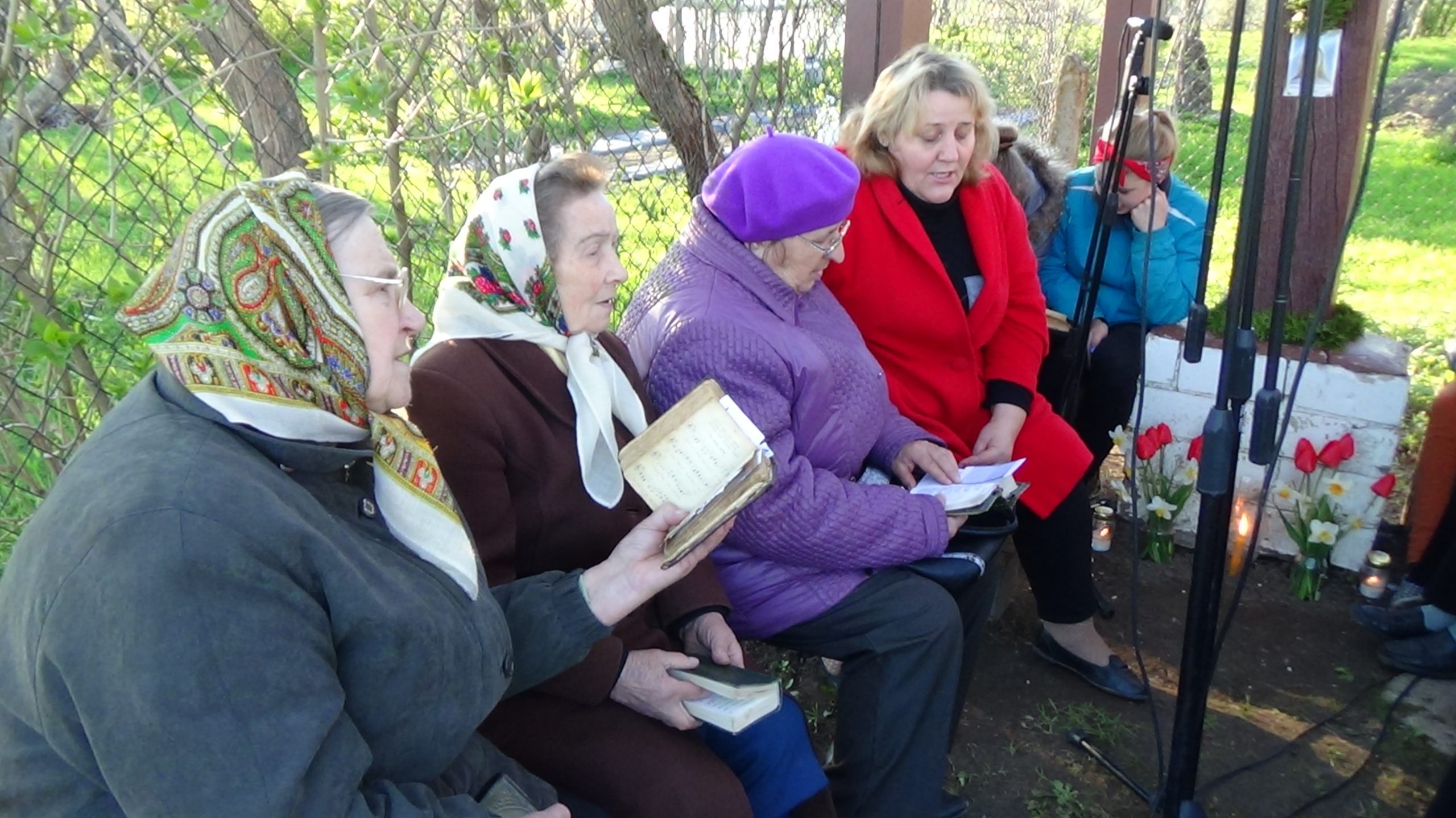
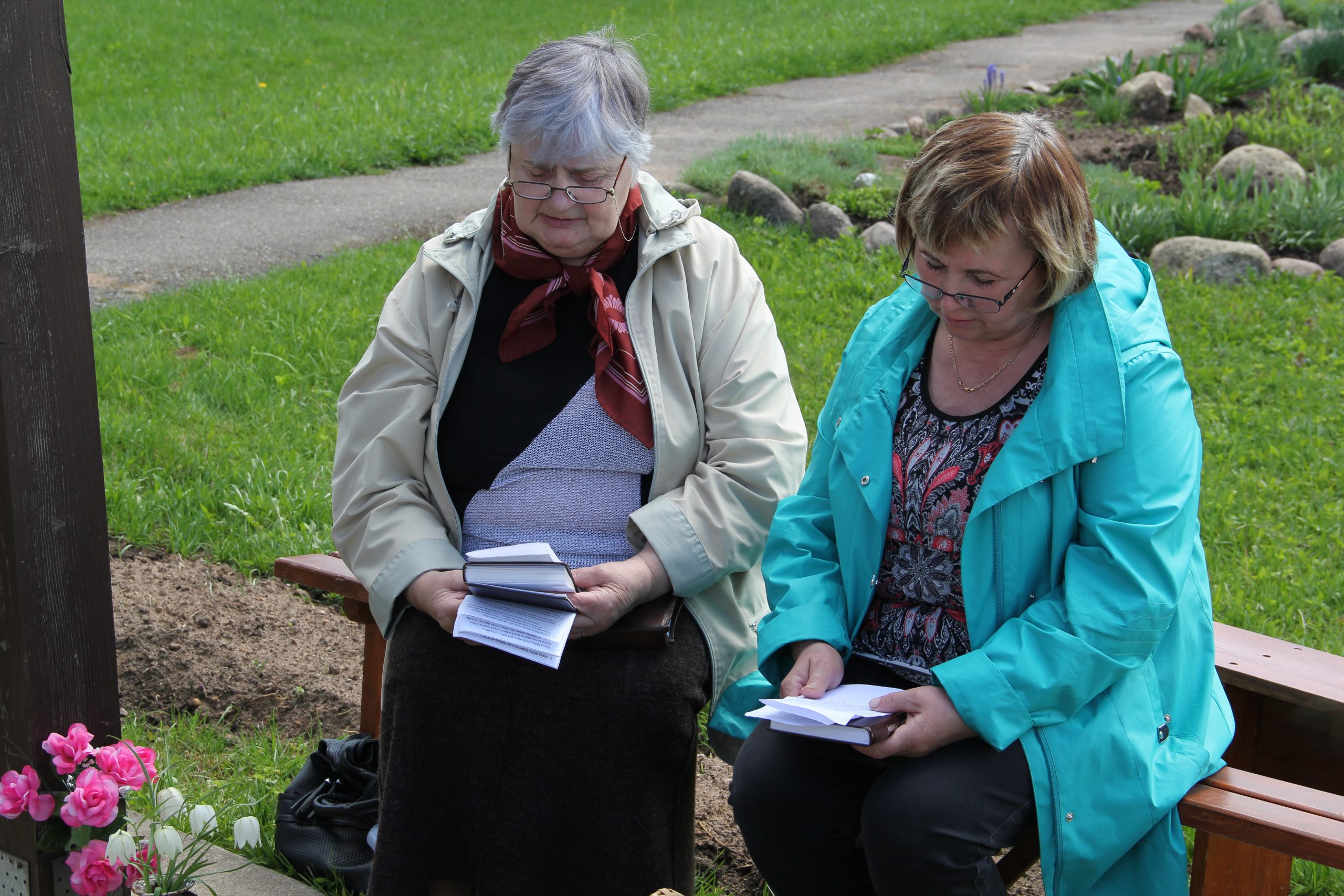
Devotional singing usually begins with the recitation of the rosary and a litany of the Holy Virgin Mary, which are followed by other Dīva dzīsmes [songs of God], which is how singers refer to the songs found in Roman Catholic prayer books. Since the entire month of May, including devotional singing, is dedicated to the Virgin Mary, songs in honor of Mary (Marijas dzīsmes) are sung most often, although songs in praise of God are also sung.
Singing takes place from prayer books, but these only contain the words. Newer editions sometimes include musical notation, but since most singers do not read music, this is of little significance. The melodies are passed on orally from generation to generation.
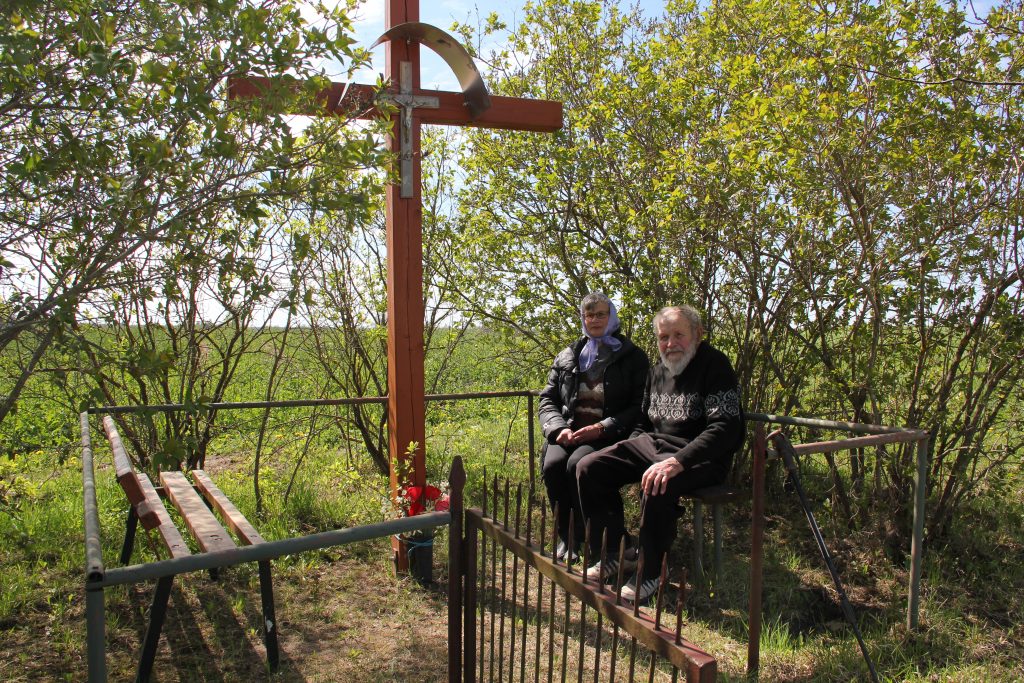
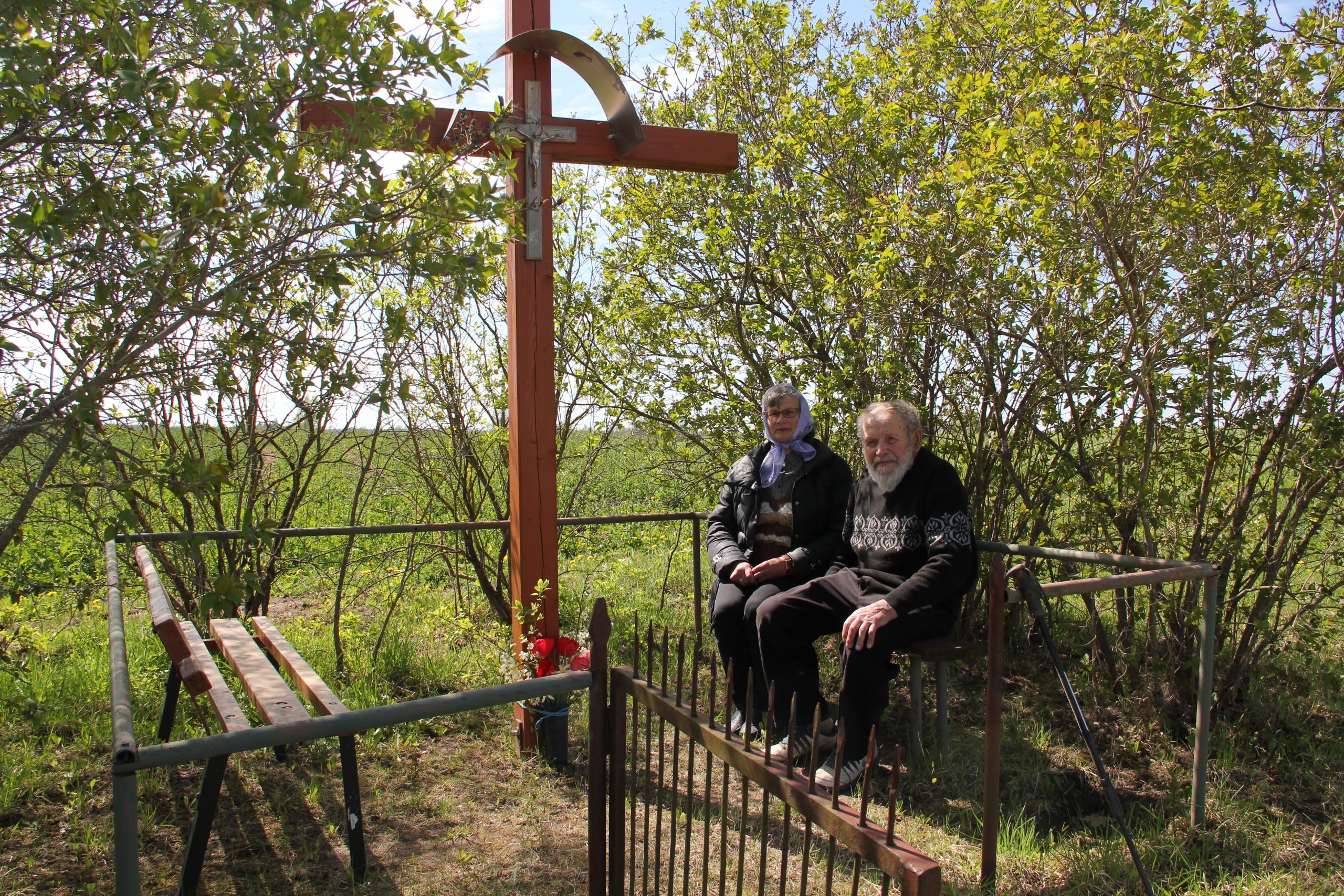
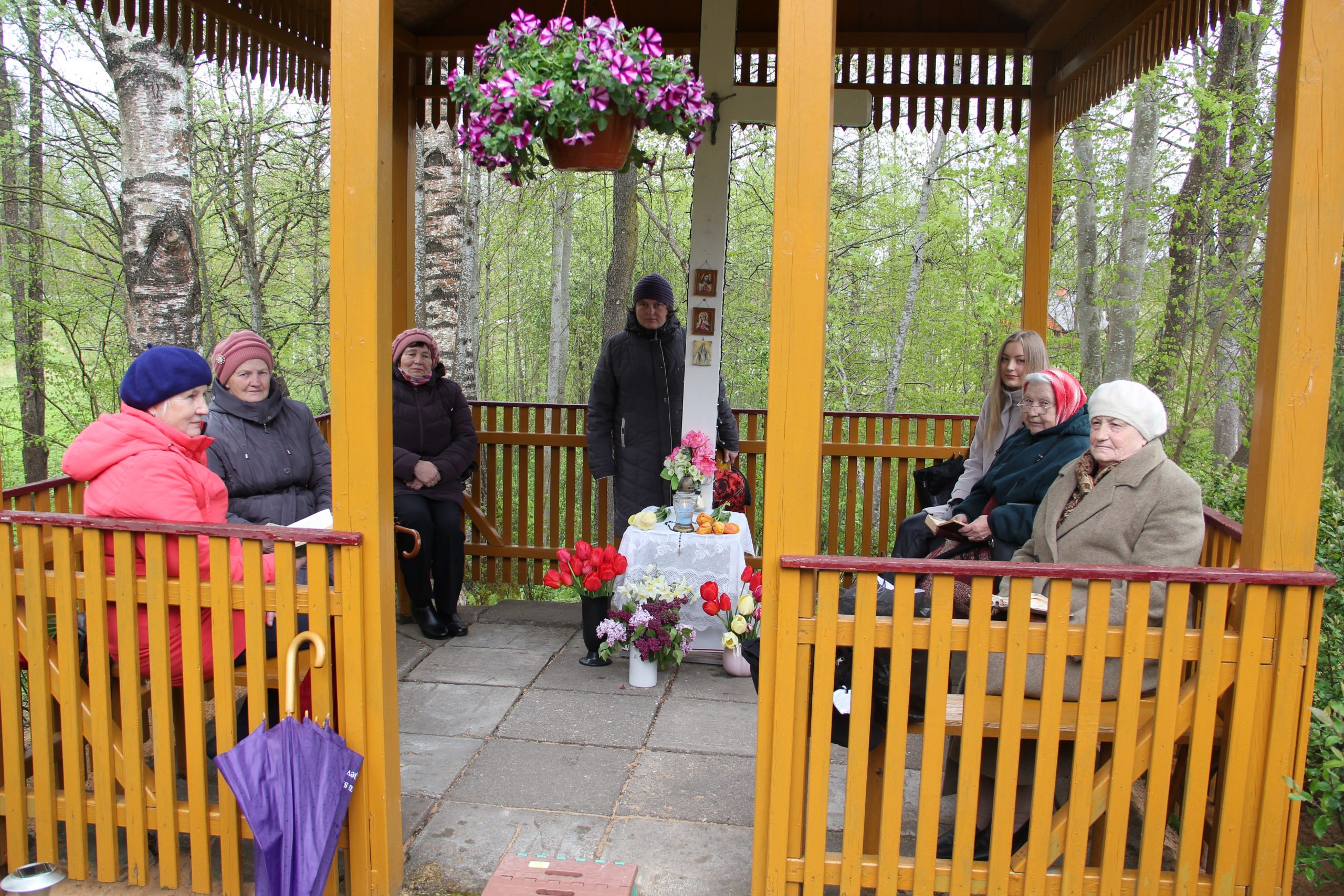
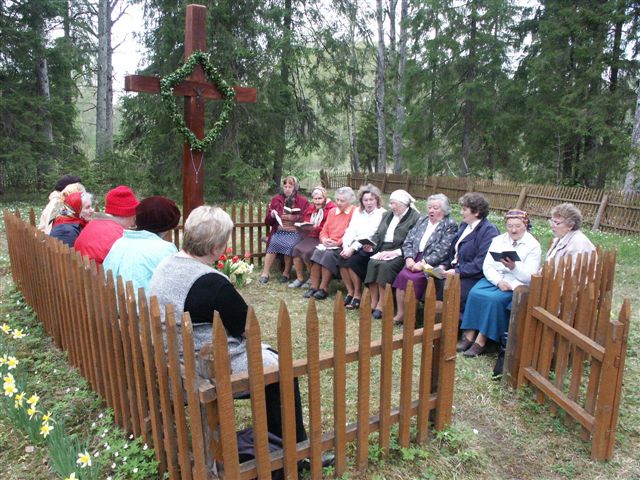
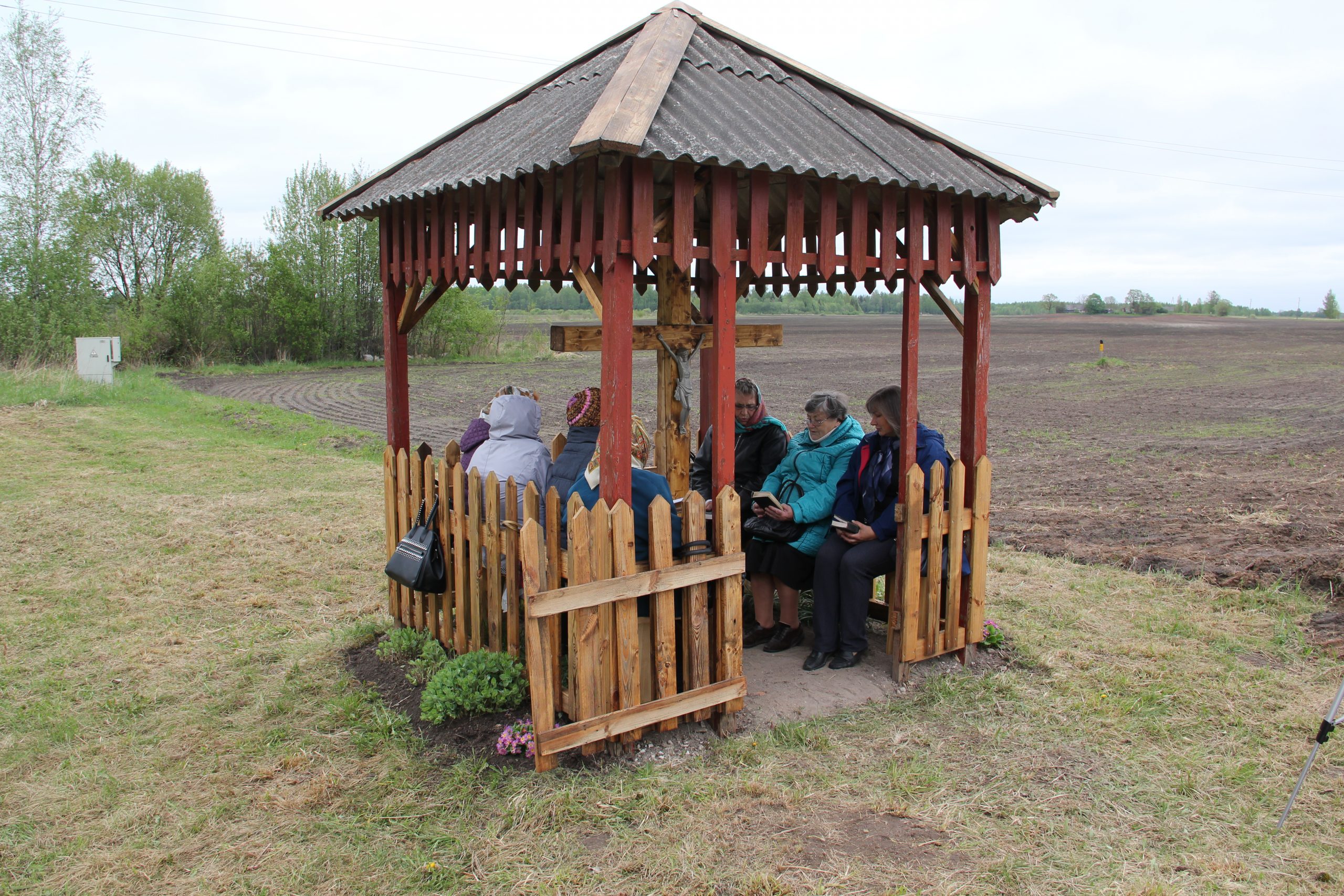
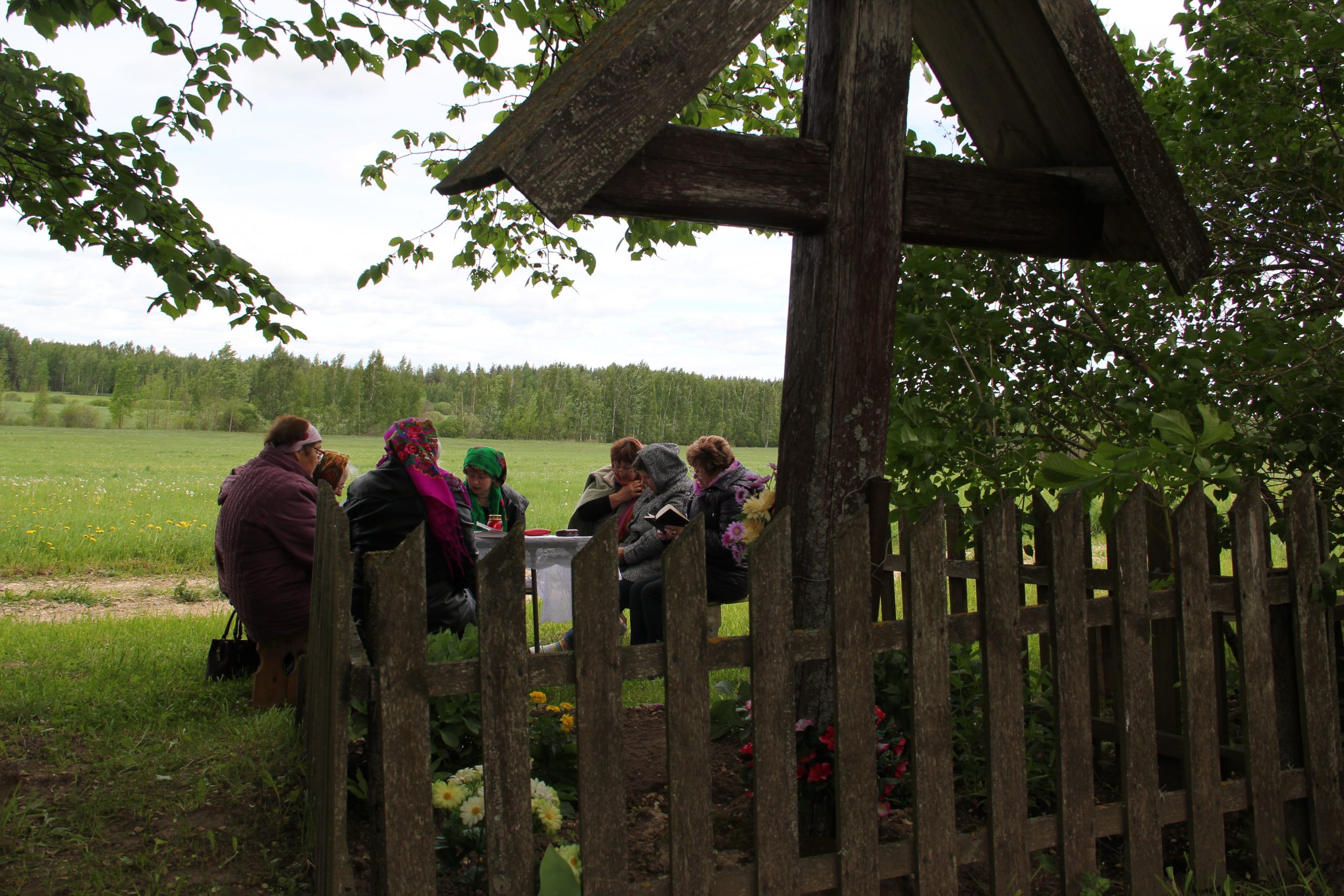
Each crucifix community has one (occasionally more than one) lead singer who selects the songs. She usually also begins the singing and the prayers. Prayers may also be said several times between songs. Singing most often takes place outdoors at crucifix sites, which are usually fenced-in enclosures with benches so that singers can sit down, since singing lasts about an hour.
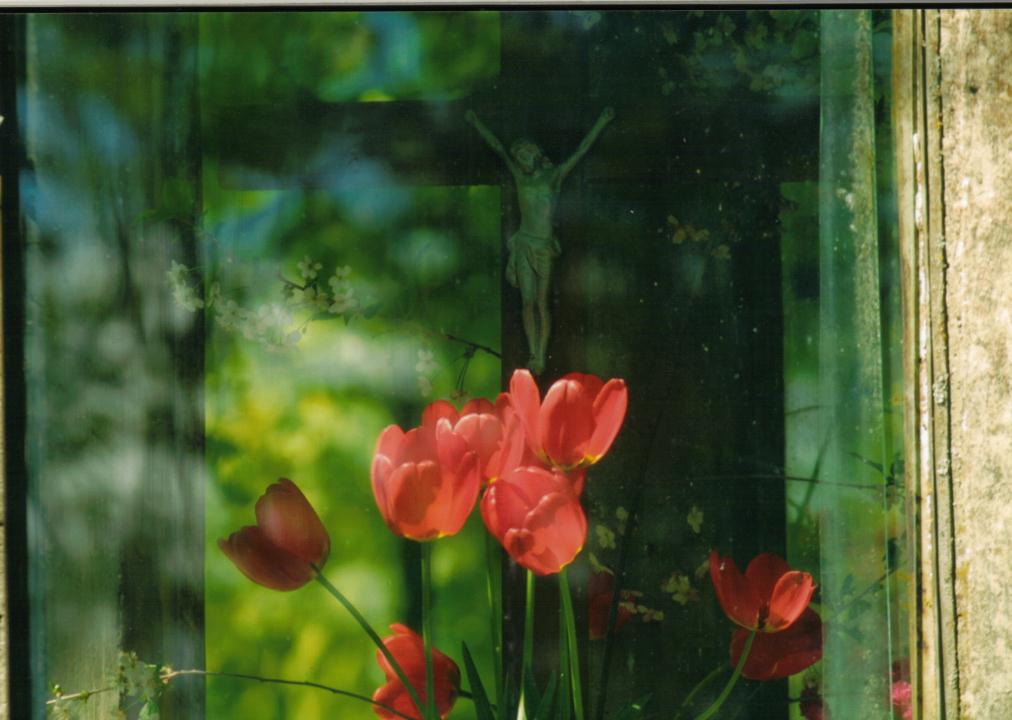
Crucifixes may be located in the middle of a village, another public place, along a roadside or at a singer’s home. The crucifixes are beautifully decorated, usually by one of the community members. In some cases, devotional singing takes place at crucifixes in cemeteries, churchyards, or inside a church.
Beliefs, rituals, and unwritten rules
On occasion, drawing “značkas” is also practiced between songs.
“Značkas” are assignments written on small pieces of paper that are to be completed in the next day, week, or month. Each participant draws a “značka” and reads it aloud. It might, for example, be an instruction to recite a particular prayer or perform a task.
It also specifies how the task must be performed, for example, to say five prayers while lying in the shape of a cross. These assignments are then conscientiously performed. The lead singer usually keeps the “značkas” in her prayer book and organizes the draw.
Inheritance and transmission
Ways of passing on the element:
• Active practice, which inspires people who are not involved in the practice but regard it with respect and awe;
• On occasion, projects are developed, for example, in Baltinava where meetings are arranged during May between youth and tradition bearers of the older generation of devotional singing;
• In some parishes (Medņeva, Vectilža, Tilža, Baltinava), specific groups travel to parishes that no longer have local tradition bearers at the invitation of culture workers or leaders of ethnographic groups, who set the schedule in advance. These events are advertised well in advance and open to other participants.
History
According to Mārtiņš Boiko, not enough research has been done to determine how long May devotional singing has been practiced. He believes it may have originated in the second half of the nineteenth century. “In Latgale and Augšzeme, they took shape as a local example of a Catholic tradition that was already widespread in the nineteenth century” (Boiko, www.letonika.lv). Devotional singing in Northern Latgale took place every evening in May until the middle of the twentieth century.
Despite the efforts of the occupying Soviet power to eradicate this tradition by destroying the crucifixes and prohibiting devotional singing, May devotional singing persisted covertly, albeit with less intensity. The practice continued either at homes, where the crucifixes were hidden, or at cemeteries. Many crucifixes were restored in the early 1990s. After Latvian independence was restored, devotional singing also made a return. It no longer took place every evening, rather once or a few times weekly or even less often.
Today, May devotional singing continues to be an integral symbol of piety and a source of pride in Northern Latgale. This is one of only a few forms of traditional culture that functions outside institutional control and as an object of concern for municipal culture workers.
In the spring of 2019, 120 crucifixes were documented in Northern Latgale. Each of these has a distinct story in terms of its appearance and the singing practices associated with it. Devotional singing takes places at approximately sixty crucifix locations at least once a month. The frequency can vary. Singing takes place every day only at the crucifix in Kubuli parish, Balvi municipality.
As the rural population declines, the number of people in these singing groups also declines.
The Bērzpils parish in Balvi municipality is an interesting example, which is a place where devotional singing takes place several times a week at eight of sixteen extant crucifixes. Each crucifix has its own small, regular group which is not organized by culture workers or the municipality. In the context of May devotional singing in Northern Latgale, Bērzpils parish has been the least touched by institutionalization.
In several other parishes, for example, Baltinava, Medņeva, Tilža and Vectilža, the local folklore group and culture workers are involved in organizing May devotional singing. This ensures that singing also takes place in locations where there are no permanent residents. There are crucifixes where a single individual sings once a month, and crucifixes where there is no activity.
Time has also brought change to the song repertoire. Less frequently singers use the so-called “old books”, which are characterized by older forms of expression and contain songs that are not found in the “new books”. It could be said that the repertoire is becoming newer, as contemporary compositions enter the tradition, often becoming popular and prevailing over the older songs.
Unfortunately, there is a tendency for the multi-part singing that was characteristic of the Northern Latgale repertoire to disappear. Unison singing is increasing.
Additional Information
The tradition is particularly cherished because of its ability to retain its deeper meaning and function without institutional participation.
However, time brings change. All four municipalities are involved with the element to varying degrees. These include Balvi Municipality, Baltinava Municipality, Rugāji Municipality, Viļaka Municipality, and their institutions.
Masters
• Celīna Kaupera, Briežuciems parish;
• Anna Pundure, Briežuciems parish;
• Silvija Slišāne, Briežuciems parish;
• Aina Logina, Briežuciems parish;
• Anastasija Gabrāne, Briežuciems parish;
• Marija Sīle, Briežuciems parish;
• Silvija Dzerkale, Briežuciems parish;
• Valentīna Keiša, Briežuciems parish;
• Valentīna Kamzola, Briežuciems parish;
• Leontīna Šakina, Briežuciems parish;
• Alla Fjodorova, Briežuciems parish;
• Līvija Ločmele, Briežuciems parish;
• Ineta Apšeniece, Briežuciems parish;
• Ināra Kamzola, Briežuciems parish;
• Valentina Ločmele, Briežuciems parish;
• Anita Pakalnīte, Briežuciems parish;
• Skaidrite Pakalnīte, Briežuciems parish;
• Maruta Ločmele, Briežuciems parish, Ošukalns;
• Maruta Ločmele, Surikova;
• Genovefa Zelča, Briežuciems parish;
• Marija Deksne, Briežuciems parish;
• Līvija Cibule, Briežuciems parish;
• Marianna Laganovska, Briežuciems parish;
• Anita Platniece, Briežuciems parish;
• Leontīna Slišāne, Briežuciems parish;
• Ilze Erdmane, Baltinava;
• Sarma Sutugova, Baltinava;
• Anele Vizule, Baltinava;
• Iveta Gabrāne, Baltinava;
• Antoņina Krakope, Baltinava;
• Anastasia Ločmele, Baltinava;
• Antonija Toma, Baltinava;
• Valentīna Daukste, Baltinava;
• Elizabete Kaņepe, Baltinava;
• Lucija Ločmele, Baltinava;
• Anna Stranga, Bērzkalne parish;
• Marta Korlaša, Bērzkalne parish;
• Irēne Sīle, Bērzkalne parish;
• Anita Šmite, Bērzkalne parish;
• Silvija Strupka, Bērzkalne parish;
• Elfrīda Ābeltiņa, Bērzkalne parish;
• Irena Jasinska, Bērzkalne parish;
• Mārīte Bondarenko, Bērzkalne parish;
• Skaidrīte Saleniece, Bērzkalne parish;
• Anna Cibule, Bērzkalne parish;
• Anna Sudare, Bērzpils parish;
• Marijanna Jurkāne, Bērzpils parish;
• Broņislava Spalviņa, Bērzpils parish;
• Biruta Bogdane, Bērzpils parish;
• Ilga Rakstiņa, Bērzpils parish;
• Anna Sideļņika, Bērzpils parish;
• Aloizs Svelpe, Bērzpils parish;
• Veronika Odumiņa, Bērzpils parish;
• Anna Bitaine, Bērzpils parish;
• Ināra Kriviša, Bērzpils parish;
• Aivita Rakstiņa, Bērzpils parish;
• Adrija Šustere, Bērzpils parish;
• Antoņina Dundeniece, Bērzpils parish;
• Stefānija Kindzule, Bērzpils parish;
• Lucija Gaspažiņa, Bērzpils parish;
• Anna Poševa, Bērzpils parish;
• Marija Švekere, Bērzpils parish;
• Anna Jurkāne, Bērzpils parish;
• Helēna Mārtuža, Bērzpils parish;
• Veronika Čudare, Bērzpils parish;
• Anna Kindzule, Bērzpils parish;
• Ingrida Svelpe, Bērzpils parish;
• Pēteris Delveris, Bērzpils parish;
• Zita Delvere, Bērzpils parish;
• Līksma Pugače, Tilža parish;
• Anna Sisojeva, Tilža parish;
• Anna Kaņepe, Tilža parish;
• Inese Zelča, Tilža parish;
• Anna Jermacāne, Tilža parish;
• Daiga Jēkabsone, Tilža parish;
• Inese Pujate, Tilža parish;
• Zane Pulča, Tilža parish;
• Ināra Indriķe, Tilža parish;
• Jolanta Kaša, Tilža parish;
• Aina Zelča, Tilža parish;
• Marija Gorščale, Kubuli parish;
• Ināra Pugeja, Kubuli parish;
• Maruta Ozola, Kubuli parish;
• Marija Bukša, Kubuli parish;
• Tekla Kozlovska, Kubuli parish;
• Ināra Kaičenko, Kubuli parish;
• Maija Osmane, Kubuli parish;
• Adelaide Pipcāne, Kubuli parish;
• Nellija Lielbārde, Kubuli parish;
• Aija Pumpure, Šķilbēni parish;
• Ineta Lapsa, Šķilbēni parish;
• Māris Pužuls, Šķilbēni parish;
• Irina Husare, Šķilbēni parish;
• Inese Slišāne, Šķilbēni parish;
• Simona Logina, Šķilbēni parish;
• Ārija Rudziša, Šķilbēni parish;
• Estere Husare, Šķilbēni parish;
• Inata Pužule, Šķilbēni parish;
• Jānis Circenis, Šķilbēni parish;
• Laurita Ločmele, Šķilbēni parish;
• Karīna Romanova, Šķilbēni parish;
• Karīna Rudziša, Šķilbēni parish;
• Kristīne Lapsa, Šķilbēni parish;
• Janīna Lapsa, Šķilbēni parish;
• Biruta Bebina, Kuprava parish;
• Velta Garā, Kuprava parish;
• Emerita Prancāne, Kuprava parish;
• Emerita Žabare, Kuprava parish;
• Edita Viļuma, Kuprava parish;
• Antonija Jermacāne, Vectilža parish;
• Inese Jermacāne, Vectilža parish;
• Sonora Logina, Vectilža parish;
• Marija Ločmele, Vectilža parish;
• Domicella Logina, Vectilža parish;
• Mārīte Logina, Vectilža parish;
• Antoņina Baltiņa, Vectilža parish;
• Mārīte Lazorenko, Vectilža parish;
• Maruta Arule, Vectilža parish;
• Inta Zaharāne, Vectilža parish;
• Natālija Šustova, Vectilža parish;
• Solveta Logina, Vectilža parish;
• Iveta Zelča, Vectilža parish;
• Elija Logina, Vectilža parish;
• Genovefa Jermacāne, Vectilža parish;
• Terēze Kaijere, Viļaka;
• Vineta Zetkalne, Viļaka;
• Anna Annuškāne, Viļaka;
• Inita Raginska, Viļaka;
• Guntars Skutels, Viļaka;
• Lidija Brokāne, Viļaka;
• Marija Pitkeviča, Viļaka;
• Evita Zaremba-Krīgere, Viļaka;
• Anita Zaremba, Viļaka;
• Lidija Šaicāne, Viļaka;
• Marta Dortāne, Viļaka;
• Valentīna Dortāne, Viļaka;
• Lūcija Šaicāne, Viļaka;
• Aldis Pušpurs, Susāji parish;
• Emerita Pranckune, Susāji parish;
• Anna Mačāne, Susāji parish;
• Anna Gabrāne, Susāji parish;
• Antoņina Kaļiņina, Susāji parish;
• Indra Mačāne, Susāji parish;
• Valentīna Romanovska, Susāji parish;
• Biruta Bukovska, Susāji parish;
• Marita Pitkeviča, Susāji parish;
• Lucija Korneva, Susāji parish;
• Vija Martuzāne, Krišjāņi parish;
• Inese Zelča, Krišjāņi parish;
• Aina Ločmele, Krišjāņi parish;
• Aina Zelča, Krišjāņi parish;
• Vitālijs Pujats, Krišjāņi parish;
• Ināra Galviņa, Krišjāņi parish;
• Ināra Zelča, Krišjāņi parish;
• Valentīna Pujate, Krišjāņi parish;
• Zenta Šakale, Krišjāņi parish;
• Lilija Zelča, Krišjāņi parish;
• Lilija Zelča, Madona;
• Sandra Ločmele, Medņeva parish;
• Helēna Locāne, Medņeva parish;
• Aina Prancāne, Medņeva parish;
• Valentīna Babāne, Medņeva parish;
• Marina Upīte, Medņeva parish;
• Anita Upīte, Medņeva parish;
• Zinta Babāne, Medņeva parish;
• Silvija Babāne, Medņeva parish;
• Malvīne Ločmele, Medņeva parish;
• Skaidrīte Šaicāne, Medņeva parish;
• Jevgenija Račāne, Vecumi parish;
• Anna Saveļjeva, Vecumi parish;
• Velta Logina, Vecumi parish;
• Maruta Kokoreviča, Vecumi parish;
• Olga Kokoreviča, Vecumi parish;
• Irēna Kuzmane, Vecumi parish;
• Elizabeta Logina, Vecumi parish;
• Genovefa Kokoreviča, Vecumi parish;
• Janīna Kokoreviča, Vecumi parish;
• Līvija Kokoreviča, Vecumi parish;
• Valentīna Keiša, Šķilbēni parish;
• Loreta Šakina, Šķilbēni parish;
• Gunita Šakina, Šķilbēni parish;
• Irmīna Slišāne, Šķilbēni parish;
• Iveta Logina, Šķilbēni parish;
• Marija Supe, Šķilbēni parish;
• Irēna Keiša, Šķilbēni parish;
• Malvina Romka, Šķilbēni parish;
• Anna Keiša, Šķilbēni parish;
• Laura Bukša, Šķilbēni parish;
• Dainis Keišs, Šķilbēni parish;
• Līvija Supe, Šķilbēni parish;
• Valentīna Mežaka, Šķilbēni parish;
• Aija Korneja, Šķilbēni parish;
• Anna Štekele, Lazdukalns parish;
• Ivars Vītols, Lazdukalns parish;
• Pēteris Jermacāns, Lazdukalns parish;
• Līga Zizlāne, Lazdukalns parish;
• Regīna Čudarāne, Lazdukalns parish;
• Iveta Uršaļska, Lazdukalns parish;
• Veronika Janiša, Lazdukalns parish;
• Vincentina Bukša, Lazdukalns parish;
• Emīlija Bondare, Lazdukalns parish;
• Līvija Luša, Lazdukalns parish;
• Zita Kuzma, Lazdukalns parish;
• Aija Ikstena, Lazdukalns parish;
• Judīte Pasikova, Lazdukalns parish;
• Valda Šmagre, Lazdukalns parish;
• Rudīte Kuzmina, Lazdukalns parish;
• Silvia Deksne, Lazdukalns parish;
• Iveta Birkova, Lazdukalns parish.
Institutions and Organizations
According to the situation in 2026, the main institution involved is the Balvi Municipality Council. The central coordinating and supporting role is played by the Balvi municipality Intangible Cultural Heritage Centre “Upīte”.
Practical work, support for tradition bearers and event organization are carried out by:
• Balvi Municipality Intangible Cultural Heritage Centre “Upīte”;
• Balvi Culture and Recreation Centre and its structural units:
Naudaskalns Parish Folk House, Kubuli Culture House, Tilža Culture and History House, Rugāji Parish Folk House, Lazdukalns Unite House un Krišjāņi Parish Folk House;
• Viļaka Culture Centre and its structural units:
Baltinava Parish Culture House, Briežuciems Folk House, Medņeva Folk House, Šķilbēni Parish Cultural Centre “Rekova”;
• Balvi Central Library;
• Balvi Municipality Culture and Tourism Department;
• “Upītes jauniešu folkloras kopa” Association;
• “Visi kopā” Association.
The inherent ability of the tradition “May hymn singing at village crosses in Northern Latgale” to exist and function in its deepest essence without institutional involvement is considered its special value. However, to ensure the sustainability and broader recognition of the tradition, close cooperation with institutions has developed today.
As of 2025, the main institution involved is the Balvi Municipality. Within its framework, the central coordinating and supportive role is fulfilled by the Balvi Municipality Culture Department.
Practical work, support for the bearers of the tradition, and the organization of events take place at the local level within four municipal associations, where the primary cooperation partners are the following cultural institutions:
• Balvi Association: Naudaskalns Community Center, Kubuli Culture House;
• Baltinava Association: Baltinava Culture House, Briežuciems Community Center, Tilža House of Culture and History;
• Rugāji Association: Rugāji Community Center, Lazdukalns Gathering House, and Krišjāņi Community Center;
• Viļaka Association: Viļaka Culture House, Medņeva Community Center, NMKC “Upīte” (the association Upīte Youth Folklore Group).
These institutions serve as the main organizational centers that cooperate with local communities and groups of singers, particularly by providing spaces for gathering. Additionally, local associations, congregations, and groups of active residents play an important role in preserving the Element, serving as the primary maintainers of the tradition.
Strengthening
• In the 1990s, the Culture Department of the Balvi Municipality publicly expressed the opinion that May singing was an essential and important part of the national culture and invited people to join the tradition. The crucifixes at which the singing is held were collected and published in the district newspaper;
• In 2001, 2004 and 2006, the May carols became an essential part of the Balvi Spiritual Music Festival;
• In 2003 and 2004, a project called “May singing at crucifixes” was carried out, which foresaw the introduction of singing groups, the documentation of songs, photo shoots and a seminar with analysis of the material produced and a forecast of the future perspective of the tradition;
• Individual parishes, such as Briežuciems and Vīksna, attracted the financing of the CKF and LEADER programs for the restoration of crucifixes;
• A photo catalog of 108 Northern Latgale crucifixes was performed in 2008 and 2009;
• In 2016, the VKKF project for the involvement of children and young people in the May singing was implemented in Baltinava municipality;
• Every year, the North Latgale newspaper “Vaduguns” devotes at least one publication to the theme of May songs. Every year, the Balvi Municipality Museum makes at least one video documentation of the singing;
• In 2019, the North Latgale crucifixes (120) were re-documented, and information about singing groups was updated.
1. PRACTICING AND POPULARIZING THE TRADITION
The viability of the Element is primarily ensured by the annual practice of May hymn singing, which is actively organized by both local ethnographic ensembles and cultural workers in Balvi Municipality. The recognition and continuity of these events are supported by the Balvi Municipality Culture Department, which compiles the events every year and promotes their popularization.
Concurrently, the circulation of information and the popularization of the tradition are also maintained across various media:
• At the regional level: Every year during May/June, a publication on this topic is featured in the newspaper Vaduguns;
• The contribution of publicist Vineta Zeltkalne must be highlighted in particular—her articles are regularly published both in Katoļu Baznīcas Vēstnesis (The Catholic Church Herald) and in the regional press, including the newspaper of the former Viļaka Municipality;
• A broader audience across Latvia is reached by Radio Marija Latvija, which endeavors almost every year to travel to Northern Latgale to broadcast live or record from a hymn singing location, later publishing it in audio and video formats.
2. DIGITIZATION OF HISTORICAL HERITAGE AND CREATION OF THE ARCHIVE
Based at the Ontons Slišāns Upīte Cultural History Museum, a multi-stage project was implemented to digitize the reel-to-reel magnetic tapes recorded by Ontons Slišāns in the 1970s, which include May hymn singings. The process was initiated in 2021 with the support of the State Culture Capital Foundation (SCCF), engaging professional Māris Keišs (recording studio Bigmaar's Records), who converted the audio recordings into digital format. In the period from 2022 to 2024, with continued support from the SCCF, post-processing of the recordings, systematic structuring of the materials, and the creation of a digital database were carried out, which were ultimately handed over to the archive of the Ontons Slišāns Upīte Cultural History Museum (the work was performed by Kate Slišāne).
3. DOCUMENTING AND RESEARCHING THE TRADITION (FIELDWORK)
In addition to preserving historical materials, documentation of the current tradition is also being carried out. Purposeful work in this area was conducted in 2025, when a field study was implemented, making new audio recordings at 12 village crosses in the parishes of Medņeva, Krišjāņi, Lazdukalns, Susāji, Baltinava, Kubuli, and Vectilža, as well as in the towns of Balvi and Viļaka.
Within the scope of this study, the viability and dynamics of the tradition were additionally recorded and analyzed, focusing on aspects vital to the existence of the element, such as the timing of the hymn singings, the order of proceedings, the selection of texts and musical material, the drawing of lots (Značku vilkšana), as well as other organizational matters and community cooperation.
All the aforementioned activities – ranging from the organizational work of local communities and cultural workers to targeted promotion in the media and research – have created a comprehensive and positive impact. They have significantly raised the visibility of the Element, carrying it beyond the borders of the Northern Latgale region and increasing both the pride of local residents and the interest of the wider public. It is particularly significant that this set of activities has fostered a growing interest among the younger generation. Modernly presented information, along with digitally accessible video and audio materials, makes the tradition engaging, alive, and easier to comprehend. At the same time, it has had a decisive impact on promoting the accessibility and deepening the understanding of the tradition. The digitization of historical audio tapes has not only saved unique recordings from disappearing but has also created the technical foundation for their widespread availability in the future. Currently, the materials are accessible for research in the collection of the Ontons Slišāns Upīte Cultural History Museum, and their publication in an online archive is planned. Meanwhile, the latest field study has captured the current practices and dynamics of the tradition. Consequently, “May hymn singing” is becoming a thoroughly documented cultural element with guaranteed continuity and the potential to become widely accessible, thereby raising its value and understanding to a new quality.
The municipalities have always provided and provide their support to address the various organizational issues. Most often it is the provision of transport for elderly wives to and from the crosses, or to events at the Open-Air Museum or other activities where the tradition of May carol singing is presented.
Municipalities are willing to participate in supporting documentation and research. This is reflected in the transport provision for local journeys, providing accommodation and catering, the preparation of the information base necessary for the preparation of research.
In some cases, municipalities engage in cross-border infrastructure management, but it is based on the Community's responsibility.
The municipalities of Briežuciems and Vīksna have attracted project funding for the restoration and arrangement of the crucifixes.
On the other hand, there are several examples where the farmer who leases and treats the plot of land on which the crucifix is located assumes responsibility for restoring it.
In Susāji parish is an example when a private person restores a crucifix (Sviļpova, Egļova) every year.
In the parish of Susāji and Vecumi, individual persons have invested funds to build crucifixes at the place of their villages, where people are no longer practically living, as well as organizing singers and transport to these places at least once in the month of May.
Individual enthusiasts regularly renew and even add to the already rich family of crucifixes in the parish of Bērzpils. The Beļauski Crucifix (Bērzpils municipality), where regular chants are held, has also welcomed the participation of restorers from the Rēzekne School of Art and Design in its restoration.
Northern Latgale is not homogeneous, but in general it is characterized by a surprising willingness of people to care about irrational things. For the time being, this process does not require an artificially organized planning. Positive communication and support are provided from local governments, when necessary.
The support of the municipality and other institutions for the tradition of “May hymn singing” is based on the principle of close cooperation and partnership, respecting community initiatives. The Balvi Municipality provides regular and purposeful support, which manifests in several ways.
Practical assistance in organizational matters is significant, especially in providing transport so that older bearers of the tradition can reach chanting sites within the municipality, and singers can attend events and festivals throughout Latvia where the heritage of Northern Latgale is presented. Similarly, the municipality actively supports the documentation and research of the tradition by helping to resolve practical matters related to the researchers' local travel, accommodation, and access to information.
With regard to the upkeep of the cross infrastructure, the primary responsibility remains in the hands of the local communities themselves, demonstrating the characteristic capacity and desire of Northern Latgale residents to care for their own cultural environment. Instead of artificially managing these processes, the municipality provides positive and responsive support whenever it is needed. This model, which respects the natural vitality of the tradition, has proven to be both effective and sustainable.
Continuation/development
To ensure the identification of the element:
• Cooperation with traditional music researchers and students will be continued through regular documenting of the May songs. At least one full recording will be made every year with the aim of covering as many and different singing groups as possible;
• Research results will be presented at local and international conferences as well as in researchers' publications;
• In the Northern Latgale newspaper “Vaduguns”, there will be at least one publication on the progress of the singing at one of the region's crucifixes every year. The development of the tradition is reflected in the “one-home” project of the society integration fund and media support fund;
• The application process for the SCCF Lifetime Scholarships and for the Regional Certificates of Recognition and Acknowledgement will continue;
• The collection and publication of singer-life stories in the cultural history database of the Baltic region will be continued;
• It is intended to continue active cooperation with “Radio Marija”, which makes regular live broadcasts from Latgale crucifixes every year. Maintain the share of Northern Latgale translations currently in the total range of broadcasts;
The implementation of the planned measures builds upon projects already initiated and supported by the State Culture Capital Foundation (SCCF): the Balvi Municipality project “May hymn singing at village crosses in Northern Latgale: research into the dynamics of the tradition” and the project of the association Upīte Youth Folklore Group on the preservation of the Intangible Cultural Heritage in the Upīte cultural space. One of the tasks of the latter project is to actively organize May hymn singings at crosses, involving ever-younger singers as inheritors of the value, and to make live recordings.
Tasks:
• The Balvi Municipality will continue its cooperation with traditional music researchers and students, making at least one full recording of hymn singings every year with the goal of covering as many and as diverse groups of singers as possible;
• Edgars Gabranovs will provide an annual publication in the Northern Latgale newspaper Vaduguns, documenting the course of hymn singing at one of the region's crucifixes;
• Vineta Zeltkalne will publish her articles during the months of May/June both in Katoļu Baznīcas Vēstnesis and in the regional press;
• The Balvi Municipality, together with Ruta Cibule, will carry out an in-depth analysis of the acquired materials, researching musical, textual, and dialectological peculiarities, as well as the dynamics of the tradition;
• Kate Slišāne and Ruta Cibule will present their research results at local and international conferences, as well as prepare research articles for publication;
• Kate Slišāne, in cooperation with Andris Slišāns, will ensure the creation and online launch of the digital archive based at the Ontons Slišāns Upīte Cultural History Museum in 2026, systematically compiling all research materials.
• Do not take any coercive or demanding action, but, by observing the processes, support requests from local governments for singing groups to resolve transport issues or infrastructure issues.
• Kate and Domeniks Slišāni will actively work on involving new singers and inheritors of the tradition by organizing experience-sharing events and masterclasses;
• The Balvi Municipality Culture Department will arrange for the nomination of the most prominent tradition bearers (teicējas) for the SCCF lifetime stipends and Balvi Municipality awards, publicly honoring their contribution;
• The Balvi Central Library will systematically collect, compile, and publish the life stories of the singers in the cultural history database of the Balvi region;
• The Balvi Municipality will maintain active cooperation with Radio Marija Latvija, ensuring a strong share of live broadcasts from Northern Latgale and regularly presenting research results at conferences and in publications;
• The Balvi Municipality will provide support based on a sustainable and respectful principle: to refrain from imposing actions, but rather, while observing the processes, to support the requests of singer groups regarding transport and infrastructure issues.
The aim of these measures is to preserve, not to lose. To promote it to attract new people. To research and document so as not to go shallow. Not to interfere, but to be present, so as not to distort or degrade.
Threats
The threat of May singing is caused by:
• The dramatic decline in the population in rural areas, including Northern Latgale;
• There is a potential threat to local form and version levelling in favor of another, possibly more popular singing option.
Applicant
Balvu novads
Image Gallery


Audio Materials
Video materials:
Publications
Beitāne, Anda. (2018). Notes from Latvia. Multipart Music in the Field. European Voices: Audiovisuals 1. Compiled and commented by Anda Beitāne. Signal processing and mastering by Varis Kurmiņš. Vienna and Riga: Department for Folk Music Research and Ethnomusicology of the University of Music and Performing Arts Vienna. Jāzeps Vītols Latvian Academy of Music.
Beitāne, Anda. (2014). “Traditional Polyphony in the Officium Defunctorum in North-Eastern Latvia”. In Proceedings of the 6th International Symposium on Traditional Polyphony. Rusudan Tsurtsumia and Joseph Jordania, eds. Tbilisi International Research Center for Traditional Polyphony of Tbilisi Vano Sarajishvili State Conservatoire, 2014, 238–245.
Cibule, Ruta. (2020). Naapsarūbežuot ar kulturys radzamū daļu. Conversation with Ruta Cibuli: [interview with Award Central Library Director Ruta Cibule]/R.Cibule, S.Ūdre// LaKuGa [e-magazine] - 11.02.2020.
Gabranovs, Edgars. (2018). Dzīd pi krustiem mūspusē: [on May singing at crucifix in Kurna, Kubuli parish]/E.Gabranovs// Vaduguns. - ISSN 1407-9844. - No. 38 (2018, May 25), p. [1]: photogr.
Logina, Zinaida. (2016). Dziedot izdzīvo dvēseles vibrācijas: ["Radio Marija Latvija” in Tilža/text is told by R.Miķelsons, I.Laupace, A.Sisojeva, R.Cibule, record Z.Logina// Vaduguns. - ISSN 1407-9844. - No. 43 (2016, 3 June), p. 5; photo.
Logina, Zinaīda. (2020).Latgalē saka, - "dzīduošona pi krysta": [about the May singing tradition at the time when the gathering together is restricted by the country-specific emergency]/Zinaīda Logina; interviews Ruta Cibule, Helēna Locāne, Malvīne Ločmele, Silvija Babāne, Anna Prancāne, Anita Upīte, Lūcija Gaspažiņa, Ingrīda Svelpe, Ilga Rakstiņa, Broņislava Spalviņa, Marija Bukša, Tekla Kozlovska // Vaduguns. - No 37 (2020, 19 May), p. 7, photo gr.
Pantele, Guna (2002). The tradition of the May Service in Eastern Latvia. Book: Materials on Culture in Latvia. Riga: Zinātne, 200-214 p.
Radio Marija. (2017). Maija dziedājumi dažādos Latgales novados 2017.gads. DVD. / Radio Marija Latvija. Rīga: Radio Marija Latvija.
Rancāne, Anna. (2003). Ja ir krusts, tad jādzied: [on Catholic tradition - May singing at the crossroads in Sviļpova and Mastarīga]/Anna Rancāne; Aivara Liepiņa photo. - Interviews Baiba Supe and Anna Mežale from Baltinava parish and Anna Štekele from Lazdukalna parish// Diena. - (Piel. Sestdiena) - ISSN 1407-1290. - (2003, 31 May), pp. 16-19: photogr.
Zeltkalne, Vineta. (2019). Ceļmalas krustu tradīcija ir dzīva: [on the preservation of the May singing to crucifixes in Viļaka]/Vineta Zeltkalne; interviews Pr. G. Skutels and M. Jeromane// Viļaka municipality. - No. 5 (2019, 28 May), p. 12: photo.
Goldhill, Vineta. (2015). How to preserve the tradition of May singing?: [the month of May is hurried, the most charming singers and the stories of traditions, sanctioned every day by God's honour at crosses, crucifixes]/Vineta Zeltkalne// Control. - ISSN 1407-9844. - No. 42 (2015. June 9), p. 8, photo.
Zinkovska, Ingrīda. (2016). Dzied dziesmas Dievmātes godam: [about the May singing traditions in Baltinava municipality]/interviews psalm singer F.Avišāne, pupil M.Laganovska, head of the Central Library in Balvi R.Cibule, record. I.Zinkovska; photo A.Kirsanovs// Control. - ISSN 1407-9844. - No. 40 (2016, 24 May), p. 8; photo.
Websites
http://balvurcb.lv/kb/index.php?CategoryID=32 - information on more than 100 North Latgale crucifixes
http://balvurcb.lv/kb/index.php?CategoryID=29 - for May songs in separate parishes, including with added publication lists
http://balvurcb.lv/kb/index.php?CategoryID=74 - for more than 100 catolic traditional music practitioners
http://balvurcb.lv/kb/index.php?CategoryID=60 - Latvian Radio Cora Expedition Materials in North Latgale in 2009, including May songs. Berzpils, Tilja, Cape, Vilaka
https://www.letonika.lv/groups/default.aspx?title=LKK%20resurss/22 - short historical insight into tradition